
Everyday Mental Illness Test
What has been taking up room in your head lately? In about five minutes you get a picture of the part of everyday experience that stands out most for you today: low mood, worry, swings, repeated checking, unusual experiences, trouble with focus, or none of them. It is a self-report, not a diagnosis, and only a licensed professional can say what a result means for you.
No sign-up. Your result right away.
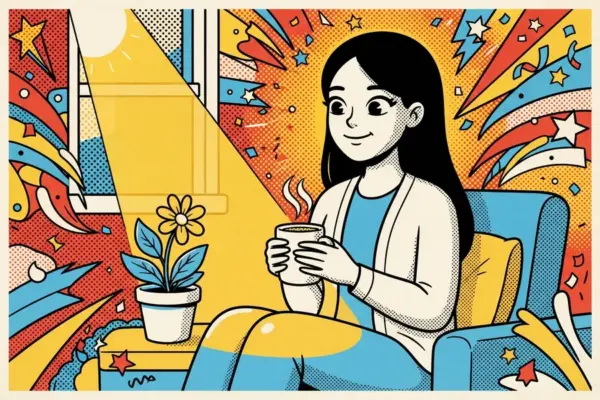
Low Tide
«A flat stretch needs no explanation before you notice it.»
The test is new — you are among the first hundred to take it.
Good news arrives, the tea is hot, and inside you the volume stays low. The old favourites ask for more effort, and your sleep or meals have slipped off their timetable. What you describe matches depression more closely than any other area.
Lingering low mood, less pull from old favourites, sleep or appetite off its pattern: that is the cluster. Your Depression percentage holds the depth, and its very bottom means nothing was recorded; low readings are ordinary background.
Today's read is relative and carries no label. A licensed professional is the one to say whether a diagnosis applies, and a conversation is worth having if this area matters in your daily life. A flat patch deserves to be taken seriously.

Wind Chimes
«Your mind runs a busy timetable of what-ifs.»
The test is new — you are among the first hundred to take it.
The train is delayed, and your thoughts leave the platform for a dentist appointment, a bill and a message from Tuesday, one after another, while your shoulders tighten. What you describe matches anxiety more closely than any other area.
Three threads run through this area: worry that hops, a keyed-up body, bracing for trouble. The result says which area leads, not how deep it goes. Your Anxiety percentage answers that; its lowest reading means nothing was recorded, and only a clearly higher one points to something standing out.
A relative reading, no more. Whether any of it goes beyond the everyday is for a licensed professional to judge, and talking with one makes sense if it weighs on your days. Your busy head deserves a serious hearing.

Weathervane
«Your pace has a range, and some weeks stretch it.»
The test is new — you are among the first hundred to take it.
You remember a week when you slept far less than usual and felt no need to rest, then a quiet week well below your usual self. What you describe matches bipolar-type mood swings more closely than any other area.
Here the cluster is a stretch that stands out from your usual self, swings between lifted and low, and more taken on with less sleep. Only the lead is named. The depth lives on your Bipolar Disorder percentage, where the very bottom means nothing was recorded.
None of this is a name given as fact; only a licensed professional can judge whether a diagnosis applies, and if this area matters in your daily life, such a conversation is worth having. A pace that changes is yours to describe.

Square Corners
«You can know the answer and still feel the question return.»
The test is new — you are among the first hundred to take it.
You lock the door, reach the stairs and turn back for one more look. The thought that sent you back is one you already know is out of proportion. What you describe matches OCD more closely than any other area.
A returning thought, an urge to repeat an action until it feels right, and time lost beyond a liking for order make up this area. It names the lead, not the depth. On your OCD percentage the very bottom means nothing was recorded, and low readings are ordinary background.
This is a read of today, not a name you now carry. Does it amount to a diagnosis? Only a licensed professional can say, and a talk is worth having if this area weighs on your days. Wanting to be sure is ordinary.

Lantern Glow
«You notice things about your days that are hard to say.»
The test is new — you are among the first hundred to take it.
In a quiet room you catch a sound, a shadow or a sense of company that nobody else in the house picked up, and you turn to check. What you describe matches psychosis-related experiences more closely than any other area.
Such impressions, a hard-to-shake belief about being watched and thoughts that feel loud or not quite yours lie on the same continuum as everyday experience. The lead is named, not the depth; your Psychosis percentage holds that, with the very bottom meaning nothing was recorded.
Treat it as a relative read of today, not a verdict. Whether it calls for a diagnosis is for a licensed professional alone, and if this area matters in your daily life, a conversation is worth having. Calm description is enough here.

Open Tabs
«You know what matters; getting to it is the hard part.»
The test is new — you are among the first hundred to take it.
The email needs one paragraph. You wash a mug, answer a message, find the charger and open three tabs, and the paragraph is still waiting at dusk. What you describe matches ADHD more closely than any other area.
Dull jobs that stall, time and belongings that slip away, a mind that outruns your hands: these make up the area. It names the lead, not the depth, which sits on your ADHD percentage; there, the very bottom means nothing was recorded and low readings are ordinary background.
Not a name given as fact, and only a relative reading of today. A licensed professional alone can judge whether a diagnosis applies; if this area matters in your daily life, talking with one is worth doing. Good intentions and a wandering attention can share a desk.

Level Horizon
«You can notice an even stretch as carefully as a rough one.»
The test is new — you are among the first hundred to take it.
A tangled week ends, and by Sunday evening your mood sits where it usually sits. Sleep, meals and the rhythm of your days are close to what you know. No single area stands out for you: mood, routine and daily life come through as even.
Your steady mood and energy, your sleep and appetite near their usual pattern, and a bad stretch that stays with its own cause are what lead here. For answers like these, nothing standing out is an ordinary, common outcome.
Your read is today's snapshot, not a guarantee, and other weeks can read differently; if something changes, talking with a professional is always possible, with no test needed to justify it. An even stretch is worth enjoying without waiting for the catch.
About this test
How this test works
The approach behind this check treats everyday emotional strain as a handful of overlapping dimensions, not as separate boxes. You describe scenes from your own days, and the answers are sorted into seven groups. Six cover low mood, worry, swings with lifted stretches, returning thoughts with repeated checking, unusual perceptual and thought experiences, and attention and follow-through. The seventh gathers a steady, uneventful stretch.
Every group draws on its own questions and gets a percentage of its own. The result names the group your answers favour most, yet all seven percentages stay on the page, so you see the whole outline and not just the front-runner.
Read it as a snapshot. Next month's answers may favour a different group. Nothing here explains why you feel as you do, forecasts where it is heading or suggests any form of care. For a plain explanation of what mental disorders are and how screening differs from diagnosis, see this plain-language overview. If one group seems relevant to your daily life, this guide to finding help shows where to turn.
This check is not a tool for diagnosing anything, and it cannot stand in for an assessment by a licensed clinician trained in mental health. Only such a clinician can tell whether a diagnosis fits you.
Frequently asked questions
Can an online quiz really say which mental illness is mine?
No. It shows which part of your days your own answers lean toward today, and that is all it does. Putting a name on a condition belongs to a licensed clinician after a thorough interview. If the area in your result keeps tugging at you, that conversation is the place to go from here.
Can I trust an online mental health screening?
A form like this reflects only what you chose to report. It can suggest where to look next, yet it cannot settle whether a condition is present or absent, and a proper assessment takes in far more than any form can.
What does the result "signs not pronounced" mean?
It means none of the six areas rose above the rest in what you reported this time. For answers like these that is an unremarkable outcome, not an odd leftover category. It describes how things read today; other weeks can read differently.
Does having these experiences mean I'm going crazy?
No. The areas covered here are familiar parts of ordinary life, and they are often approachable with support. A result names an area so you can see what you have been noticing; it is a description, not a judgment about you.
Sources
- Kotov, R., Krueger, R. F., Watson, D., Achenbach, T. M., Althoff, R. R., Bagby, R. M., et al. (2017). The Hierarchical Taxonomy of Psychopathology (HiTOP): A dimensional alternative to traditional nosologies. Journal of Abnormal Psychology, 126(4), 454–477. doi:10.1037/abn0000258.
- Kroenke, K., Spitzer, R. L., & Williams, J. B. W. (2001). The PHQ-9: Validity of a brief depression severity measure. Journal of General Internal Medicine, 16(9), 606–613. doi:10.1046/j.1525-1497.2001.016009606.x.
- Kocalevent, R.-D., Hinz, A., & Brähler, E. (2013). Standardization of the depression screener Patient Health Questionnaire (PHQ-9) in the general population. General Hospital Psychiatry, 35(5), 551–555. doi:10.1016/j.genhosppsych.2013.04.006.
Breakdown
There's a reason you answer the way you do
Most tests show you a slice of who you are. This one gets to the core: the classic 16-type personality test that goes back to Carl Jung, rebuilt from the ground up and way more accurate. It takes ten minutes, you only ever do it once — and you walk away with an answer most people never quite figure out: why you are the way you are. Why some people just get you, and why with others it's complicated. And that answer won't change: your type is yours for life.
Take the free testHow you compare
The test is new — you are among the first hundred to take it.
About this test
How this test works
The approach behind this check treats everyday emotional strain as a handful of overlapping dimensions, not as separate boxes. You describe scenes from your own days, and the answers are sorted into seven groups. Six cover low mood, worry, swings with lifted stretches, returning thoughts with repeated checking, unusual perceptual and thought experiences, and attention and follow-through. The seventh gathers a steady, uneventful stretch.
Every group draws on its own questions and gets a percentage of its own. The result names the group your answers favour most, yet all seven percentages stay on the page, so you see the whole outline and not just the front-runner.
Read it as a snapshot. Next month's answers may favour a different group. Nothing here explains why you feel as you do, forecasts where it is heading or suggests any form of care. For a plain explanation of what mental disorders are and how screening differs from diagnosis, see this plain-language overview. If one group seems relevant to your daily life, this guide to finding help shows where to turn.
This check is not a tool for diagnosing anything, and it cannot stand in for an assessment by a licensed clinician trained in mental health. Only such a clinician can tell whether a diagnosis fits you.
Frequently asked questions
Can an online quiz really say which mental illness is mine?
No. It shows which part of your days your own answers lean toward today, and that is all it does. Putting a name on a condition belongs to a licensed clinician after a thorough interview. If the area in your result keeps tugging at you, that conversation is the place to go from here.
Can I trust an online mental health screening?
A form like this reflects only what you chose to report. It can suggest where to look next, yet it cannot settle whether a condition is present or absent, and a proper assessment takes in far more than any form can.
What does the result "signs not pronounced" mean?
It means none of the six areas rose above the rest in what you reported this time. For answers like these that is an unremarkable outcome, not an odd leftover category. It describes how things read today; other weeks can read differently.
Does having these experiences mean I'm going crazy?
No. The areas covered here are familiar parts of ordinary life, and they are often approachable with support. A result names an area so you can see what you have been noticing; it is a description, not a judgment about you.
Sources
- Kotov, R., Krueger, R. F., Watson, D., Achenbach, T. M., Althoff, R. R., Bagby, R. M., et al. (2017). The Hierarchical Taxonomy of Psychopathology (HiTOP): A dimensional alternative to traditional nosologies. Journal of Abnormal Psychology, 126(4), 454–477. doi:10.1037/abn0000258.
- Kroenke, K., Spitzer, R. L., & Williams, J. B. W. (2001). The PHQ-9: Validity of a brief depression severity measure. Journal of General Internal Medicine, 16(9), 606–613. doi:10.1046/j.1525-1497.2001.016009606.x.
- Kocalevent, R.-D., Hinz, A., & Brähler, E. (2013). Standardization of the depression screener Patient Health Questionnaire (PHQ-9) in the general population. General Hospital Psychiatry, 35(5), 551–555. doi:10.1016/j.genhosppsych.2013.04.006.
