
Helen Fisher Personality Test
Ever noticed how some invitations get a yes before they finish, while others make you check the calendar twice? Answer small scenes from everyday life and you get a portrait: which of four styles (Explorer, Builder, Director or Negotiator) leads your answers, with the other three shown beside it. It takes about six minutes. Think of it as a light self-report on habits, a friendly look at yourself and nothing grander.
No sign-up. Your result right away.

Explorer
«That detour sign? You read it as an invitation.»
The test is new — you are among the first hundred to take it.
The restaurant you planned is full, so you follow a stranger's tip to a place with no sign and a handwritten menu. Dinner is a surprise, and you are delighted. Among your four styles, Explorer is the one that came out strongest in your answers.
You say yes to the unplanned thing and sort out the details on the way. Long, repeating work is where you get tested: a big project can feel like a waiting room, and your change of course can look like trouble finishing. You keep the other three styles too, each on its own scale, and close scores are ordinary.
Staying with one thing until you know every corner of it is the pleasure you keep for later. Side streets suit you; just leave a bookmark on the main road.
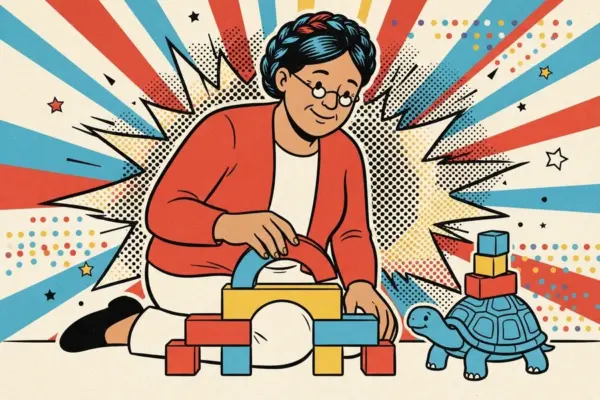
Builder
«Your future self will thank you for this spreadsheet.»
The test is new — you are among the first hundred to take it.
The group trip is a week off, and you already hold the booking numbers, a backup route and a list of who brings what. Nobody asked for it; everybody quietly relies on it. Among your four styles, Builder is the one that came out strongest in your answers.
Promises stick to you, and so do house rules; a choice that can't be reversed gets a long look first. That is why people lean on you. Sudden turns rattle you more than they thrill you, and the shiny untried option waits longer for its fair hearing.
Your other three styles are still on the page, and a near-tie with one of them is nothing to worry about. Leaping with no map isn't your sport. Keep the binder, since somebody has to know where the tickets are.

Director
«Clear beats comfortable, and you say so.»
The test is new — you are among the first hundred to take it.
The group chat is dithering over where to eat, and you write one line: the pasta place, 7pm, and the reason. Within a minute, three thumbs up. Among your four styles, Director is the one that came out strongest in your answers.
Facts decide, you say what you think in plain words, and a goal of your own gets more push when it turns hard. In the moment that can cost some warmth, because feelings, yours included, are weighed after the numbers, and your calm face can read as distance.
You carry the other three styles as well, shown on their own scales, and two of them running close is a perfectly normal picture. Starting with warmth and sorting out facts afterwards isn't how you are built. Be clear, then be kind about it.

Negotiator
«You hear the mood before anyone says a word.»
The test is new — you are among the first hundred to take it.
Two friends are bickering over a map in the car, and you have already found a route that lets both of them be right. Neither notices you did it. Among your four styles, Negotiator is the one that came out strongest in your answers.
You tune in to people and to how things join up, so when two sides clash you go looking for the version both can accept. Tact has an edge cost: a clean call by the rules, or a talk that really has to happen, can sit softened for longer than helps. Your other three styles keep their own scales on the page, and a near-tie between two is nothing odd.
Numbers-only calls aren't where you shine; you make sure the room can live with the decision.
About this test
How this test works
This test follows an approach that splits everyday personality into four wide behavioural styles, each scored on its own line, not as four boxes. The researchers behind it suggest each style is tied to a different brain system (serotonin, dopamine, testosterone, and a pairing of estrogen and oxytocin). That is their proposal, not a reading of your biology, and nothing here measures a hormone or a neurotransmitter. The approach sits inside the wider idea of temperament, the biologically rooted base of personality that shows from early on.
Your answers are tallied on four lines: novelty and spontaneity, structure and loyalty to the established, logic and directness, people and the wider web of connections. Each item offers answers from weaker to stronger expression of its own line, while the remaining lines get a fixed small contribution whatever you choose. The largest total names your result, and the rest remain on view as separate scales.
On the evidence: a much larger independent study confirmed the main trait correlations, yet it also found sizeable overlap with better-known trait models, which the claim of being new understates. The link to brain activity rests on two small correlational studies tied to one task, and the programme itself produced most of the work. Mainstream personality research does not rank the approach with the leading models; careful independent study is still thin. No dependable figures exist for how widespread each style is. Results describe only your own style, for any gender and any relationship situation.
Frequently asked questions
What are the four styles in this personality test?
They are Explorer, Builder, Director and Negotiator, four everyday styles of behaviour that are scored separately. Explorer leans toward new things and decisions made on the move. Builder leans toward plans, rules and long-kept commitments. Director leans toward logic and plain speaking. Negotiator leans toward people and the way things connect. Every person gets a score on each of the four, and your result is the one that scored highest for you.
How accurate is this personality test?
The questions are about you, so what comes back is the shape of your own replies, not a measurement taken from outside. Like any questionnaire, it is only as accurate as you are truthful and steady while answering. Treat the result as a fair snapshot of your habits on the day you took it.
Is this personality test backed by science?
One considerably larger independent study backed up the main links between traits, which counts for a lot. Still, most of the evidence comes from the programme's own authors, in the form of a big questionnaire sample and two small scanning studies, and personality researchers do not rank the approach beside the best-known trait models. A fair summary: promising, but not yet proven to the standard of those models.
Which style is the rarest, and which is the most common?
There is no reliable, checkable data on how widespread each style is. Websites that pose the question quote figures that conflict with each other and cannot be verified, so this page offers no number and no ranking. The test only shows where your own answers landed on the four scales.
Which style is compatible with which?
The test describes your own style and nothing else. It passes no verdict on any particular relationship and names no ideal style for anyone to pair with. It is a tool for understanding yourself, not for matchmaking or for rating compatibility.
Sources
- Fisher, H. E., Island, H. D., Rich, J., Marchalik, D., & Brown, L. L. (2015). Four broad temperament dimensions: description, convergent validation correlations, and comparison with the Big Five. Frontiers in Psychology, 6, 1098. doi:10.3389/fpsyg.2015.01098
- Brown, L. L., Acevedo, B., & Fisher, H. E. (2013). Neural correlates of four broad temperament dimensions: testing predictions for a novel construct of personality. PLOS ONE, 8(11), e78734. doi:10.1371/journal.pone.0078734
- Alkalay, S., Mizrachi, Y., & Agasi, E. (2022). Toward a biological basis of the FFM meta-traits: associations between the Fisher Type Indicator (FTI) temperament construct and the hierarchical Five Factor Model (FFM) of personality. Personality and Individual Differences, 185, 111266. doi:10.1016/j.paid.2021.111266
Three more tests on the same theme



Breakdown
There's a reason you answer the way you do
Most tests show you a slice of who you are. This one gets to the core: the classic 16-type personality test that goes back to Carl Jung, rebuilt from the ground up and way more accurate. It takes ten minutes, you only ever do it once — and you walk away with an answer most people never quite figure out: why you are the way you are. Why some people just get you, and why with others it's complicated. And that answer won't change: your type is yours for life.
Take the free testHow you compare
The test is new — you are among the first hundred to take it.
Three more tests on the same theme
About this test
How this test works
This test follows an approach that splits everyday personality into four wide behavioural styles, each scored on its own line, not as four boxes. The researchers behind it suggest each style is tied to a different brain system (serotonin, dopamine, testosterone, and a pairing of estrogen and oxytocin). That is their proposal, not a reading of your biology, and nothing here measures a hormone or a neurotransmitter. The approach sits inside the wider idea of temperament, the biologically rooted base of personality that shows from early on.
Your answers are tallied on four lines: novelty and spontaneity, structure and loyalty to the established, logic and directness, people and the wider web of connections. Each item offers answers from weaker to stronger expression of its own line, while the remaining lines get a fixed small contribution whatever you choose. The largest total names your result, and the rest remain on view as separate scales.
On the evidence: a much larger independent study confirmed the main trait correlations, yet it also found sizeable overlap with better-known trait models, which the claim of being new understates. The link to brain activity rests on two small correlational studies tied to one task, and the programme itself produced most of the work. Mainstream personality research does not rank the approach with the leading models; careful independent study is still thin. No dependable figures exist for how widespread each style is. Results describe only your own style, for any gender and any relationship situation.
Frequently asked questions
What are the four styles in this personality test?
They are Explorer, Builder, Director and Negotiator, four everyday styles of behaviour that are scored separately. Explorer leans toward new things and decisions made on the move. Builder leans toward plans, rules and long-kept commitments. Director leans toward logic and plain speaking. Negotiator leans toward people and the way things connect. Every person gets a score on each of the four, and your result is the one that scored highest for you.
How accurate is this personality test?
The questions are about you, so what comes back is the shape of your own replies, not a measurement taken from outside. Like any questionnaire, it is only as accurate as you are truthful and steady while answering. Treat the result as a fair snapshot of your habits on the day you took it.
Is this personality test backed by science?
One considerably larger independent study backed up the main links between traits, which counts for a lot. Still, most of the evidence comes from the programme's own authors, in the form of a big questionnaire sample and two small scanning studies, and personality researchers do not rank the approach beside the best-known trait models. A fair summary: promising, but not yet proven to the standard of those models.
Which style is the rarest, and which is the most common?
There is no reliable, checkable data on how widespread each style is. Websites that pose the question quote figures that conflict with each other and cannot be verified, so this page offers no number and no ranking. The test only shows where your own answers landed on the four scales.
Which style is compatible with which?
The test describes your own style and nothing else. It passes no verdict on any particular relationship and names no ideal style for anyone to pair with. It is a tool for understanding yourself, not for matchmaking or for rating compatibility.
Sources
- Fisher, H. E., Island, H. D., Rich, J., Marchalik, D., & Brown, L. L. (2015). Four broad temperament dimensions: description, convergent validation correlations, and comparison with the Big Five. Frontiers in Psychology, 6, 1098. doi:10.3389/fpsyg.2015.01098
- Brown, L. L., Acevedo, B., & Fisher, H. E. (2013). Neural correlates of four broad temperament dimensions: testing predictions for a novel construct of personality. PLOS ONE, 8(11), e78734. doi:10.1371/journal.pone.0078734
- Alkalay, S., Mizrachi, Y., & Agasi, E. (2022). Toward a biological basis of the FFM meta-traits: associations between the Fisher Type Indicator (FTI) temperament construct and the hierarchical Five Factor Model (FFM) of personality. Personality and Individual Differences, 185, 111266. doi:10.1016/j.paid.2021.111266
