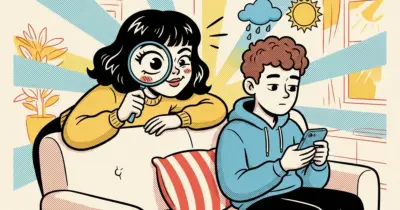
Why Does My Boyfriend Hate Me Quiz
“Does he hate me, or am I imagining it?” is a tiring question to carry around. This quiz can’t look inside him, so it won’t try. What it can do is name the picture your own answers point to. It takes about three minutes. Answer with what you’ve actually seen and heard, and read the result as one side of the story and a place to start thinking.
No sign-up. Your result right away.

Tinted Lens
«How you feel about the two of you shades the next moment.»
The test is new — you are among the first hundred to take it.
He answers with one word, or glances at his phone while you’re mid-sentence, and something in you sits up straight. Each moment is small alone, yet together they feel like a pattern. The moments are murky to begin with, and your overall feeling is what fills them in.
That doesn’t make the worry imaginary. A general feeling about a relationship seeps into how you take the next unclear moment, and what you noticed did happen.
The catch is that through a tinted lens small things come across louder, and from inside that’s hard to hear. Whether someone outside would read the same handful of moments your way is something one account can’t answer. Your noticing counts; what you conclude from it can wait.

Carousel
«You start on the dishes and end up on who you are.»
The test is new — you are among the first hundred to take it.
A row about the bins picks up a sneer, and suddenly it’s about your tone, your family, your way of doing things. You both go to bed with nothing mended, and the subject waits by the door. Laid end to end, these are fights that climb and leave no repair.
A flare-up like this turns up in steady couples too, so one alone says little. The link to strain is with couples where they dominate and repair goes missing. How many of your recent rows ended with a real sorry?
What sends him up the ladder stays off the page: you can see the pattern, but not its cause. The loop is what deserves the attention here, and it doesn’t need a villain.

Snail Shell
«You raise it, and the room goes quiet.»
The test is new — you are among the first hundred to take it.
You pick a gentle moment and say what’s on your mind, and he gets busy with the phone, the dishes, the garage. What comes back is a word or nothing. In your telling, the distance opens at the very minute you try to shorten it.
More pressing tends to bring more distance. It’s a recognised rhythm between two people and says little about your phrasing.
Why he steps back isn’t something this picture can establish. Opening the conversation alone is real work, and you deserve to see it counted as that.

Weather Front
«What you describe sounds like weather arriving from outside your door.»
The test is new — you are among the first hundred to take it.
The sharp replies land around his deadlines and bills, then the air clears. You can line the cold up with his calendar better than with anything between the two of you. As you tell it, the strain starts outside the relationship and lands on you.
Pressure from work, money or family is known to shorten tempers at home and to tint how you read the next ambiguous moment, whichever way the relationship itself is going.
How long the pressure lasts, and whether the two of you come out the other side unchanged, this picture can’t tell you. A calm week proves as little as a rough one. Still, you’re the one standing in the weather, and that counts.

Checked Calendar
«You find yourself clearing plans, money and time with him first.»
The test is new — you are among the first hundred to take it.
Where you’ll be, who with, what went on the card: the questions come in more detail than the moment calls for, and you start answering before they’re asked. You brace before you raise anything. This reads as a pattern of control, a different thing from a bad week.
It has a category to itself: what you describe isn’t a sharper fight, a longer silence or a heavier month. Accounts of this kind of pattern stress that it holds steady over time, which is why it gets a result of its own.
If you recognise this, there is more to read on this pattern in the methodology section below, offered as information to have. You know your own days better than any quiz does, and nothing here speaks to his motives.
About this test
How this test works
The quiz works the way research on couples’ everyday interaction does: it asks about specific things you can see in one relationship, like how an argument unfolds, what happens when you raise a worry, and how his mood lines up with the rest of his life. Your answers are then matched against a handful of patterns that have each been studied separately.
Every answer is your account of someone else’s behaviour, written from where you stand now, so the measurement is weak by design. Two people in the same relationship could describe the same week differently.
Start with what it leaves out: anything he hasn’t told you himself, what is going on in his head, and whether he dislikes you. None of that is visible from here. What it does look at is which of five explanations sits closest to your account: your own outlook shading an unclear picture, a separate pattern of control, pressure from outside spilling into the relationship, a partner who steps back when you try to talk, or fights that escalate without repair.
For background, two reference pages, both in English: an overview of controlling behaviour in relationships, which the control result points to, and an overview of how put-downs, scorn, defensiveness and retreat pile up in conflict, which gives context for escalating fights. Both are general background only.
In plain terms: this quiz has no way to know what he feels or intends, and what it describes is a pattern in your own account. A result about control is a separate picture and not the worst version of the other four. A calm result, or one that lands on your own lens, doesn’t mean nothing deserves attention; it means this particular picture isn’t the one you described.
Frequently asked questions
Can a quiz show whether my boyfriend really hates me?
No. Nothing in it can reach what he feels. The twelve everyday scenes collect only what you have seen and heard, and the result sorts that into a recognisable pattern. It describes your account, not his inner life.
Why does my boyfriend seem to hate me for no reason?
Coldness that seems to come from nowhere often has a shape that is hard to see from inside. Sometimes it follows pressure in his life from work, money or family. Sometimes your overall mood about the relationship is tinting ambiguous moments, sometimes fights climb without repair, and sometimes he steps back whenever you try to talk. The quiz points to whichever fits your account best. It cannot supply a reason that only he could give.
Is it normal when a boyfriend acts like he hates you?
One clipped answer or one sour evening says little by itself, and steady couples have both. What counts is the shape of many moments taken together, and that is what the quiz looks at. It does not grade whether your relationship is normal.
Is it controlling behaviour or just a rough patch?
It could be, which is why the quiz gives it a result of its own instead of treating it as the top end of the other four. If your answers point there, the result says so in calm terms and directs you to the background reading listed under the methodology. It describes a picture, not his reasons.
Why does my boyfriend go from loving me to hating me overnight?
Sharp swings between warm and cold tend to have a rhythm behind them. Outside pressure that comes and goes can produce one, and so can fights that flare and fade. Both can look like a feeling that flips, and the result separates the two readings so you can see which one your answers resemble.
Sources
- Gottman, J. M., & Levenson, R. W. (1992). Marital processes predictive of later dissolution: Behavior, physiology, and health. Journal of Personality and Social Psychology, 63(2), 221–233. doi:10.1037/0022-3514.63.2.221
- Christensen, A., & Heavey, C. L. (1990). Gender and social structure in the demand/withdraw pattern of marital conflict. Journal of Personality and Social Psychology, 59(1), 73–81. doi:10.1037/0022-3514.59.1.73
- Hawkins, M. W., Carrère, S., & Gottman, J. M. (2002). Marital sentiment override: Does it influence couples' perceptions? Journal of Marriage and Family, 64(1), 193–201. doi:10.1111/j.1741-3737.2002.00193.x
- Neff, L. A., & Karney, B. R. (2004). How does context affect intimate relationships? Linking external stress and cognitive processes within marriage. Personality and Social Psychology Bulletin, 30(2), 134–148. doi:10.1177/0146167203255984
Three more tests on the same theme


Breakdown
There's a reason you answer the way you do
Most tests show you a slice of who you are. This one gets to the core: the classic 16-type personality test that goes back to Carl Jung, rebuilt from the ground up and way more accurate. It takes ten minutes, you only ever do it once — and you walk away with an answer most people never quite figure out: why you are the way you are. Why some people just get you, and why with others it's complicated. And that answer won't change: your type is yours for life.
Take the free testHow you compare
The test is new — you are among the first hundred to take it.
Three more tests on the same theme
About this test
How this test works
The quiz works the way research on couples’ everyday interaction does: it asks about specific things you can see in one relationship, like how an argument unfolds, what happens when you raise a worry, and how his mood lines up with the rest of his life. Your answers are then matched against a handful of patterns that have each been studied separately.
Every answer is your account of someone else’s behaviour, written from where you stand now, so the measurement is weak by design. Two people in the same relationship could describe the same week differently.
Start with what it leaves out: anything he hasn’t told you himself, what is going on in his head, and whether he dislikes you. None of that is visible from here. What it does look at is which of five explanations sits closest to your account: your own outlook shading an unclear picture, a separate pattern of control, pressure from outside spilling into the relationship, a partner who steps back when you try to talk, or fights that escalate without repair.
For background, two reference pages, both in English: an overview of controlling behaviour in relationships, which the control result points to, and an overview of how put-downs, scorn, defensiveness and retreat pile up in conflict, which gives context for escalating fights. Both are general background only.
In plain terms: this quiz has no way to know what he feels or intends, and what it describes is a pattern in your own account. A result about control is a separate picture and not the worst version of the other four. A calm result, or one that lands on your own lens, doesn’t mean nothing deserves attention; it means this particular picture isn’t the one you described.
Frequently asked questions
Can a quiz show whether my boyfriend really hates me?
No. Nothing in it can reach what he feels. The twelve everyday scenes collect only what you have seen and heard, and the result sorts that into a recognisable pattern. It describes your account, not his inner life.
Why does my boyfriend seem to hate me for no reason?
Coldness that seems to come from nowhere often has a shape that is hard to see from inside. Sometimes it follows pressure in his life from work, money or family. Sometimes your overall mood about the relationship is tinting ambiguous moments, sometimes fights climb without repair, and sometimes he steps back whenever you try to talk. The quiz points to whichever fits your account best. It cannot supply a reason that only he could give.
Is it normal when a boyfriend acts like he hates you?
One clipped answer or one sour evening says little by itself, and steady couples have both. What counts is the shape of many moments taken together, and that is what the quiz looks at. It does not grade whether your relationship is normal.
Is it controlling behaviour or just a rough patch?
It could be, which is why the quiz gives it a result of its own instead of treating it as the top end of the other four. If your answers point there, the result says so in calm terms and directs you to the background reading listed under the methodology. It describes a picture, not his reasons.
Why does my boyfriend go from loving me to hating me overnight?
Sharp swings between warm and cold tend to have a rhythm behind them. Outside pressure that comes and goes can produce one, and so can fights that flare and fade. Both can look like a feeling that flips, and the result separates the two readings so you can see which one your answers resemble.
Sources
- Gottman, J. M., & Levenson, R. W. (1992). Marital processes predictive of later dissolution: Behavior, physiology, and health. Journal of Personality and Social Psychology, 63(2), 221–233. doi:10.1037/0022-3514.63.2.221
- Christensen, A., & Heavey, C. L. (1990). Gender and social structure in the demand/withdraw pattern of marital conflict. Journal of Personality and Social Psychology, 59(1), 73–81. doi:10.1037/0022-3514.59.1.73
- Hawkins, M. W., Carrère, S., & Gottman, J. M. (2002). Marital sentiment override: Does it influence couples' perceptions? Journal of Marriage and Family, 64(1), 193–201. doi:10.1111/j.1741-3737.2002.00193.x
- Neff, L. A., & Karney, B. R. (2004). How does context affect intimate relationships? Linking external stress and cognitive processes within marriage. Personality and Social Psychology Bulletin, 30(2), 134–148. doi:10.1177/0146167203255984
