
Quiet BPD Test
You say fine, the day moves on, and whatever is heavy stays with you? These everyday scenes show how much of what weighs on you, what you blame yourself for and what strains your closest relationships stays inside rather than showing. In about five minutes you get a picture of your pattern, not a score. It rests on self-report and cannot replace a conversation with a professional.
No sign-up. Your result right away.

Window Seat
«You say the small thing while it is still small.»
The test is new — you are among the first hundred to take it.
A friend cancels dinner at the last minute. You text back that it stung and ask about Thursday, and by the time the kettle clicks off it is behind you. Your answers show the inward pattern as barely there: what weighs on you comes out in words.
The flip side of saying things early is that you sometimes report a sting that has melted by dinner, so your friends get the draft rather than the edit. At work the same habit gets you the clarifying question before the guessing starts.
Keep the habit: it is why small things stay small for you.

Low Simmer
«Now and then you let a feeling simmer instead of serving it.»
The test is new — you are among the first hundred to take it.
A flat reply lands at breakfast, and you let it simmer through the morning before deciding it was nothing. Your answers show light, occasional signs of the pattern: what weighs on you and strains your closest ties turns inward on some days and comes out as words on others.
Elsewhere you say sorry a beat before you know whose fault it was, or go quiet in a chat for an evening. Then the mood passes and you are back. The price is that a quiet evening can pass for a calm one, even to you.
So far this is a visitor, and the same total can come from many different mixes, so only you know which visits to keep short.
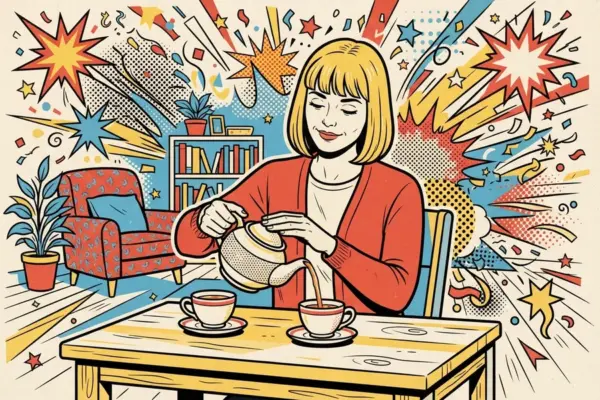
Two Cups
«One cup for the room, one for you, poured unevenly.»
The test is new — you are among the first hundred to take it.
Which cup do you fill first when a remark stings at the table? Some days it is yours, some days everyone else's. Your answers show a mixed picture: part of the inward pattern fits you, and part of it does not.
On Monday you tell a colleague the plan irritates you; by Friday you are drafting an apology for having said anything.
That is a crossing spot where about as much fits you as does not, and a few different answers would have tipped you either way. Treat the middle as information: it says you have more say over which cup comes first than you might think.

Full Arms
«You carry the whole stack so nobody has to ask.»
The test is new — you are among the first hundred to take it.
On the doorstep, keys in hand, you say fine and carry the day in under your arm, where only your shoulders can find it. That is the picture your answers paint: a clear, marked pattern of heaviness, self-blame and tension with people close to you staying inside.
A dry reply becomes your fault, a cooler tone sends you quiet, and the composed face holds up better than you do. That steadiness has a cost: nobody can help with a load they cannot see.
A reasonable next step is talking this through with a qualified professional; the links at the end of this page are a place to start. The load is real, and you are allowed to put part of it down in front of someone.

Rainy Day
«The weather in you stays indoors, out of everyone's sight.»
The test is new — you are among the first hundred to take it.
You sit through an evening with friends, laugh in the right places and carry it home untouched, and by morning it is simply how the day starts. Your answers show strong, wide signs of heaviness turning inward.
The effort works so well that others take it for ease, which leaves the load with you.
This describes the strength of a measured pattern in your answers. It is not a diagnosis and confirms no named condition. The label this topic is searched under is no diagnostic category, so nobody can diagnose it; only a licensed professional, through interview and history, can diagnose an actual condition.
A reasonable next step is a conversation with a qualified professional; the links at the end of this page are a place to start. What you carry deserves to be said out loud to someone.
About this test
How this test works
WOWtests asks what you do with strain in your relationships: whether what weighs on you comes out in words or stays inside. You describe your thoughts, feelings and actions in everyday scenes across five parts of life, with the same five answer options each time. Some scenes run the opposite way, so agreeing cannot inflate the result, and the five levels are cut where a result starts to mean something different rather than at even intervals.
It relies on your report, says nothing about why a pattern exists or where it is heading, and cannot tell a pattern that has become a clinical matter from a gentler version of the same habit, a line professionals draw with difficulty. The same total can come from different blends of the five areas.
Researchers have described this pattern, but the nickname quiet BPD is only a nickname: no major diagnostic manual lists it. Not even a clinician can diagnose the phrase; they can assess for an actual disorder, through conversation and your history. A questionnaire holds far less.
For how assessment works, see how a diagnosis is reached; for when to seek support, see knowing when you need help.
This is not a diagnostic tool and no substitute for a clinician's evaluation. It diagnoses neither quiet BPD, a label no diagnostic manual includes, nor the disorder people usually mean by it.
Frequently asked questions
Is quiet BPD a real diagnosis?
No. Quiet BPD is a nickname used online and in everyday talk, and no diagnostic manual lists it as a condition, a variant or a qualifier. The phrase grew out of older clinical writing about people who look capable and composed while struggling privately, and a single book for clinicians gave it its name. What stands behind the nickname is real, though: researchers have studied, in separate projects, a pattern in which distress is kept inside instead of shown. That pattern, not the nickname, is what this quiz measures.
Can a quiet BPD test diagnose me?
No. A diagnosis comes from a trained clinician, who spends time talking with you, asks about your history and often checks other explanations first. No questionnaire settles it on its own. Because the nickname is not a diagnosis to begin with, nobody can confirm it under that name either. The first link in the methodology section explains how an assessment works in practice.
What are the signs of keeping everything inside?
The quiz looks at five areas of everyday life instead of one telltale sign: how capable you look compared with how you feel; whether you go quiet when things between you and someone close turn tense; how steady you feel as yourself from one setting to the next; how you carry what is heavy, in your body or replaying in your head; and whether blame lands on you first.
How is this different from the louder version people usually picture?
Both describe the same struggle showing up in opposite ways. This quiz is about the version that stays inside: reactions swallowed in silence, blame turned on yourself, a retreat into quiet and a calm face on top. The louder version people usually picture shows itself outwardly, in strong feelings expressed toward others. Neither phrase is an official category; each is an informal way of describing what the struggle looks like from outside.
What can I do if this sounds like me?
The quiz offers a picture of your pattern, nothing more. If it weighs heavily on your daily life, it makes sense to bring it to someone trained in mental health, which is also the direction the higher results point in. The second link in the methodology section is a calm, plain page on where to turn first.
Sources
- Triantafyllou, A., Stefanatou, P., Konstantakopoulos, G., Giannoulis, E., & Malogiannis, I. (2025). Unveiling the Layers of Borderline Personality Disorder: A Systematic Review of Clinical Subtypes. Behavioral Sciences, 15(7), 928. doi:10.3390/bs15070928
- James, L. M., & Taylor, J. (2008). Revisiting the Structure of Mental Disorders: Borderline Personality Disorder and the Internalizing/Externalizing Spectra. British Journal of Clinical Psychology, 47(4), 361–380. doi:10.1348/014466508X299691
- Smits, M. L., Feenstra, D. J., Bales, D. L., de Vos, J., Lucas, Z., Verheul, R., & Luyten, P. (2017). Subtypes of Borderline Personality Disorder Patients: A Cluster-Analytic Approach. Borderline Personality Disorder and Emotion Dysregulation, 4, 16. doi:10.1186/s40479-017-0066-4
- Wilkinson-Ryan, T., & Westen, D. (2000). Identity Disturbance in Borderline Personality Disorder: An Empirical Investigation. American Journal of Psychiatry, 157(4), 528–541.
Three more tests on the same theme



Breakdown
There's a reason you answer the way you do
Most tests show you a slice of who you are. This one gets to the core: the classic 16-type personality test that goes back to Carl Jung, rebuilt from the ground up and way more accurate. It takes ten minutes, you only ever do it once — and you walk away with an answer most people never quite figure out: why you are the way you are. Why some people just get you, and why with others it's complicated. And that answer won't change: your type is yours for life.
Take the free testHow you compare
The test is new — you are among the first hundred to take it.
Three more tests on the same theme
About this test
How this test works
WOWtests asks what you do with strain in your relationships: whether what weighs on you comes out in words or stays inside. You describe your thoughts, feelings and actions in everyday scenes across five parts of life, with the same five answer options each time. Some scenes run the opposite way, so agreeing cannot inflate the result, and the five levels are cut where a result starts to mean something different rather than at even intervals.
It relies on your report, says nothing about why a pattern exists or where it is heading, and cannot tell a pattern that has become a clinical matter from a gentler version of the same habit, a line professionals draw with difficulty. The same total can come from different blends of the five areas.
Researchers have described this pattern, but the nickname quiet BPD is only a nickname: no major diagnostic manual lists it. Not even a clinician can diagnose the phrase; they can assess for an actual disorder, through conversation and your history. A questionnaire holds far less.
For how assessment works, see how a diagnosis is reached; for when to seek support, see knowing when you need help.
This is not a diagnostic tool and no substitute for a clinician's evaluation. It diagnoses neither quiet BPD, a label no diagnostic manual includes, nor the disorder people usually mean by it.
Frequently asked questions
Is quiet BPD a real diagnosis?
No. Quiet BPD is a nickname used online and in everyday talk, and no diagnostic manual lists it as a condition, a variant or a qualifier. The phrase grew out of older clinical writing about people who look capable and composed while struggling privately, and a single book for clinicians gave it its name. What stands behind the nickname is real, though: researchers have studied, in separate projects, a pattern in which distress is kept inside instead of shown. That pattern, not the nickname, is what this quiz measures.
Can a quiet BPD test diagnose me?
No. A diagnosis comes from a trained clinician, who spends time talking with you, asks about your history and often checks other explanations first. No questionnaire settles it on its own. Because the nickname is not a diagnosis to begin with, nobody can confirm it under that name either. The first link in the methodology section explains how an assessment works in practice.
What are the signs of keeping everything inside?
The quiz looks at five areas of everyday life instead of one telltale sign: how capable you look compared with how you feel; whether you go quiet when things between you and someone close turn tense; how steady you feel as yourself from one setting to the next; how you carry what is heavy, in your body or replaying in your head; and whether blame lands on you first.
How is this different from the louder version people usually picture?
Both describe the same struggle showing up in opposite ways. This quiz is about the version that stays inside: reactions swallowed in silence, blame turned on yourself, a retreat into quiet and a calm face on top. The louder version people usually picture shows itself outwardly, in strong feelings expressed toward others. Neither phrase is an official category; each is an informal way of describing what the struggle looks like from outside.
What can I do if this sounds like me?
The quiz offers a picture of your pattern, nothing more. If it weighs heavily on your daily life, it makes sense to bring it to someone trained in mental health, which is also the direction the higher results point in. The second link in the methodology section is a calm, plain page on where to turn first.
Sources
- Triantafyllou, A., Stefanatou, P., Konstantakopoulos, G., Giannoulis, E., & Malogiannis, I. (2025). Unveiling the Layers of Borderline Personality Disorder: A Systematic Review of Clinical Subtypes. Behavioral Sciences, 15(7), 928. doi:10.3390/bs15070928
- James, L. M., & Taylor, J. (2008). Revisiting the Structure of Mental Disorders: Borderline Personality Disorder and the Internalizing/Externalizing Spectra. British Journal of Clinical Psychology, 47(4), 361–380. doi:10.1348/014466508X299691
- Smits, M. L., Feenstra, D. J., Bales, D. L., de Vos, J., Lucas, Z., Verheul, R., & Luyten, P. (2017). Subtypes of Borderline Personality Disorder Patients: A Cluster-Analytic Approach. Borderline Personality Disorder and Emotion Dysregulation, 4, 16. doi:10.1186/s40479-017-0066-4
- Wilkinson-Ryan, T., & Westen, D. (2000). Identity Disturbance in Borderline Personality Disorder: An Empirical Investigation. American Journal of Psychiatry, 157(4), 528–541.
